

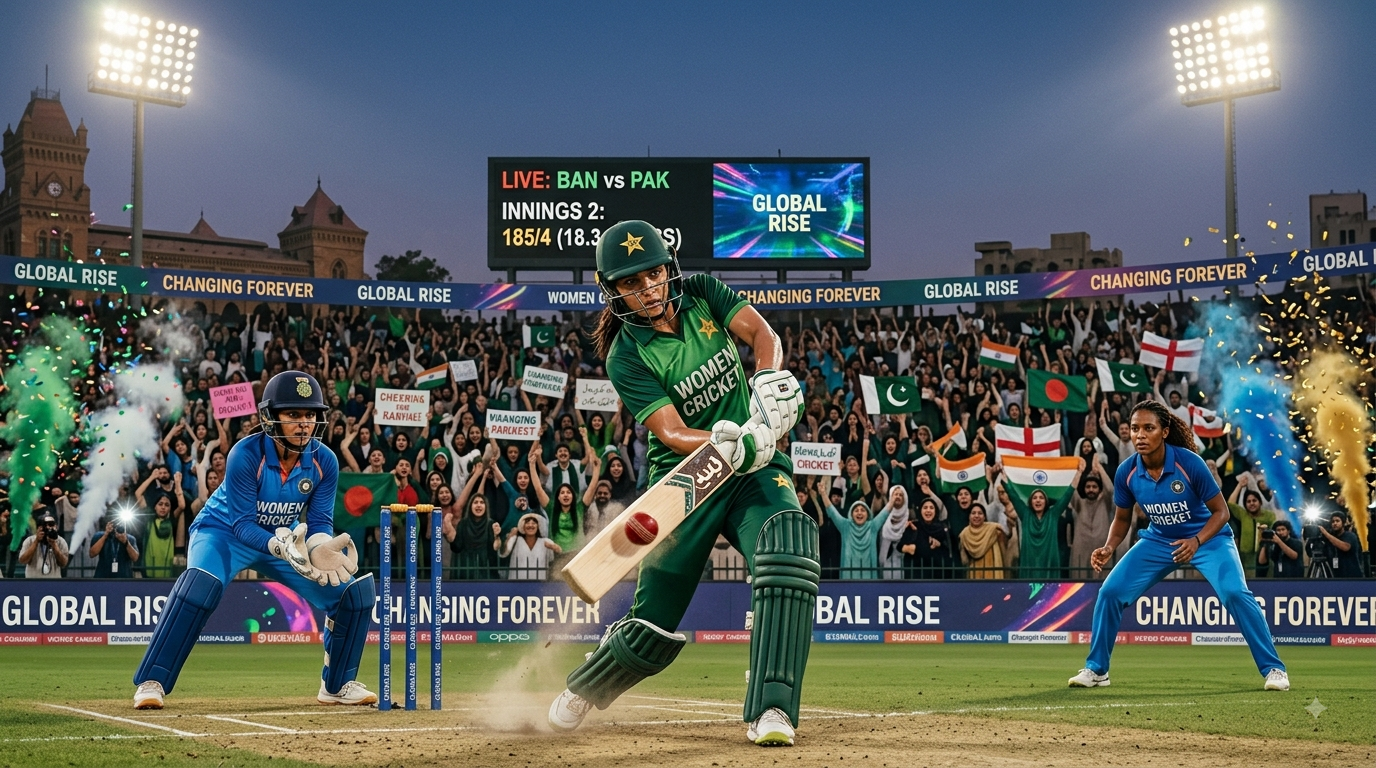
For decades, the sporting world viewed women’s sports through a reductive lens—often treated as a secondary offering or an afterthought to men’s competitions. Today, that narrative has been completely rewritten. The rapid growth of **women cricket** represents one of the most explosive and transformative developments in modern sports history. From sold-out modern stadiums and record-breaking broadcast ratings to historic pay parity initiatives and lucrative franchise leagues, **women cricket** has stepped out from the shadows into prime-time global entertainment.
This meteoric rise is not an overnight accident. It is the result of years of grassroots advocacy, strategic commercial investment, structural policy reforms, and an incredible surge of elite athletic talent. As the sport prepares for high-profile international tournaments and its monumental return to the Olympic stage, the ascent of **women cricket** is reshaping how fans, broadcasters, and sponsors interact with the game.
—
## 1. From Humble Beginnings to Mainstage Dominance
To appreciate where **women cricket** stands today, one must examine its historical trajectory. The inaugural Women’s Cricket World Cup was played in England in 1973—two full years before the first men’s World Cup was organized in 1975. Despite this early initiative, female players faced immense systemic hurdles for decades, including underfunded facilities, lack of media coverage, and minimal financial compensation. Most athletes were forced to balance full-time jobs with rigorous international training schedules.
The turning point occurred over the last decade as international cricket boards integrated women’s governance into their primary operational frameworks. The 2020 ICC Women’s T20 World Cup final at the Melbourne Cricket Ground (MCG) served as a major watershed moment, drawing a historic crowd of 86,174 spectators. That landmark match proved beyond doubt that fans were eager to fill iconic venues to watch elite women athletes compete at the highest level.
Since that milestone, momentum has accelerated rapidly:
* **Massive Broadcast Audiences:** Global viewership for major women’s international tournaments now rivals major men’s sporting events, with hundreds of millions tuning in across digital platforms and television networks.
* **Media Rights Expansion:** Unbundling women’s media and sponsorship rights from men’s properties has allowed broadcast networks to commercialize the women’s game as an independent, high-value entertainment product.
* **Cultural Resonance:** Star players have evolved into international household names, becoming influential brand ambassadors and inspiring millions of young girls around the globe to pick up a bat and ball.
—
## 2. The Commercial Revolution and Franchise Leagues
While international tournaments laid the foundation, the arrival of franchise-based T20 leagues injected financial momentum into **women cricket**. Following the success of Australia’s Women’s Big Bash League (WBBL) and England’s The Hundred, the launch of India’s Women’s Premier League (WPL) in 2023 fundamentally shifted the sport’s economic center of gravity.
Franchise sports have turned **women cricket** into a lucrative multi-million-dollar industry. High-profile auctions and team retentions now see top international stars earning life-changing contracts.
“`
Key Commercial Milestones in Women’s Franchise Cricket:
• Multimillion-Dollar Player Contracts: Top international superstars command high-value auction bids in major leagues like the WPL.
• Unbundled Sponsorship Pools: Corporate brands directly partner with women’s teams, recognizing the distinct demographic engagement of female sports audiences.
• Expanded Global Talent Pipeline: Franchise leagues provide Associate nation players direct access to elite coaching, world-class facilities, and competitive exposure.
“`
The success of these franchise leagues goes far beyond athlete compensation. They have elevated the overall standard of the international game. Emerging domestic players now share dressing rooms with seasoned international legends, dramatically accelerating the transfer of tactical knowledge, mental toughness, and professional standards across every participating nation.
—
## 3. Policy Reforms: The Pursuit of Pay Parity and Institutional Support
The commercial boom in **women cricket** has been matched by progressive policy reforms from governing bodies worldwide. For generations, pay inequality was a defining barrier for female cricketers. However, leading national boards have made institutional commitments to close the gap.
1. **Match Fee Parity:** Landmark decisions by national boards—including New Zealand Cricket, the Board of Control for Cricket in India (BCCI), Cricket South Africa, and the England and Wales Cricket Board (ECB)—ensured that female players receive equal match fees to their male counterparts for international fixtures.
2. **Equalization of World Cup Prize Money:** The International Cricket Council (ICC) implemented equal prize money for men’s and women’s ICC events, marking a major step forward in establishing systemic equality across world sports.
3. **Central Contracts and Infrastructure:** Modern female cricketers benefit from fully professional central contracts, enabling them to dedicate 100% of their focus to athletic performance, strength training, and tactical development without financial uncertainty.
These structural policy changes send a clear signal: **women cricket** is no longer viewed as a developmental project, but as a core pillar of the sport’s global economic engine.
—
## 4. On-Field Evolution: Athleticism, Power, and Tactical Innovation
As financial support and physical conditioning have reached professional standards, the technical quality of **women cricket** has soared to unprecedented heights. Today’s game is faster, bolder, and far more dynamic than ever before.
### Explosive Power-Hitting and High Scoring Rates
In the short formats of the game, power-hitting has revolutionized scoring strategies. Higher strike rates, frequent 150+ team totals in T20s, and consistent boundary-clearing abilities have become mandatory requirements. Players regularly execute sophisticated shots—such as ramp shots, reverse scoops, and power-swipes—with total confidence under pressure.
### Advanced Bowling Crafts and Tactical Depth
Bowling variations have evolved in tandem with batting aggression:
* **Spin Mastery:** Wrist-spinners and tactical off-spinners use subtle variations in speed, flight, and seam position to deceive aggressive batters.
* **Pace and Movement:** Fast bowlers are consistently pushing higher velocity thresholds, using lethal yorkers, slower-ball knuckleballs, and bouncers to dictate terms in the powerplay and death overs.
* **Dynamic Fielding:** Modern fielding standards feature extraordinary athleticism, spectacular boundary catches, and high-speed throw-outs that regularly alter match outcomes.
“`
Systemic Progression of the Modern Game:
Grassroots Programs ──► Professional Academies ──► Franchise Exposure ──► High-Performance International Cricket
“`
—
## 5. Global Expansion and the Olympic Horizon
One of the most exciting aspects of the rise of **women cricket** is its ability to break into non-traditional markets. While men’s cricket historically centered around traditional Test-playing nations, women’s cricket has seen massive engagement across Associate countries such as Thailand, Brazil, the United States, and Rwanda.
National boards in these developing markets have used T20 cricket to build successful, competitive women’s teams from scratch. In many emerging regions, the women’s national team is outperforming the men’s setup in international rankings, proving that targeted investment in female athletics yields rapid returns.
| Milestone Area | Historic Era (Pre-2015) | Modern Era (2020s & Beyond) |
| — | — | — |
| **Employment Status** | Semi-professional / Part-time | Fully professional central contracts |
| **Prizemoney & Pay** | Substantial disparity | Equal match fees & quadrupled World Cup prize pools |
| **Domestic Infrastructure** | Amateur regional circuits | High-value global franchise leagues (WPL, WBBL, The Hundred) |
| **Global Recognition** | Niche audience coverage | Prime-time broadcasts & LA 2028 Olympic inclusion |
The inclusion of cricket in the **2028 Los Angeles Olympic Games** marks a golden opportunity for global expansion. Olympic participation unlocks government sports funding, national academy access, and widespread institutional support across dozens of nations where cricket was previously a minor sport. The T20 format at the Olympics will expose **women cricket** to billions of new fans worldwide.
—
## The Path Ahead: Sustaining the Momentum
While the rise of **women cricket** is cause for celebration, maintaining this growth trajectory requires deliberate planning. Key areas that demand continuous nurture include:
* **Expanding Grassroots Networks:** Building dedicated academies, school leagues, and talent pathways to ensure young girls have seamless access to coaching and equipment.
* **Broadening International Competitiveness:** Investing in Associate nations to narrow the competitive gap between top-tier teams and emerging countries, creating more unpredictable and exciting international matches.
* **Workload Management and Player Welfare:** Balancing international schedules with franchise commitments to protect athlete physical health and mental well-being.
—
## Conclusion: A Game Changed Forever
The journey of **women cricket** from overlooked pastime to global powerhouse is one of the greatest success stories in modern sports. It stands as a testament to the perseverance of early pioneers, the vision of forward-thinking administrators, and the undeniable talent of today’s elite athletes.
With record broadcast numbers, equal pay mandates, high-stakes franchise competitions, and an Olympic future on the horizon, **women cricket** is no longer chasing recognition—it is leading the evolution of global sport. As barriers continue to fall and new generations of players take the field, one thing is abundantly clear: the game has changed forever, and its brightest chapter is only just beginning.